

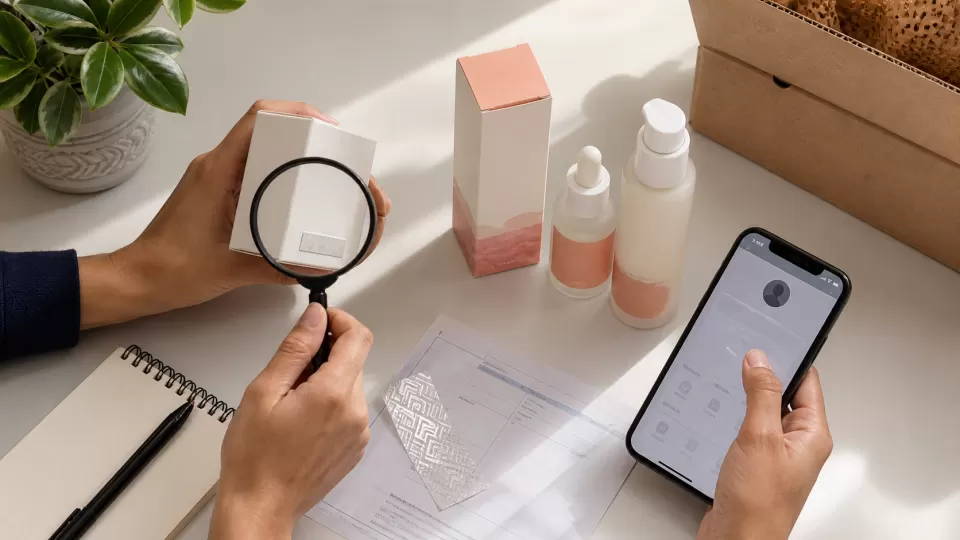
Key Takeaways
- No single packaging clue proves that a Korean skincare product is fake. Judge the seller, invoice, importer details, batch information, packaging and product together.
- Imported cosmetics sold in India are regulated under the Cosmetics Rules, 2020. Labels should include required product and importer or registration information, although permitted India-specific stickers can be legitimate.
- Buy from a traceable retailer, marketplace-authorised seller or brand-listed channel and keep the tax invoice.
- A working barcode or QR code does not prove authenticity; codes can be copied. Verify through an official brand system only when the brand confirms that method.
- Stop using a product that smells, looks or feels unexpectedly different, or causes a significant reaction. Report concerns to the seller, platform, brand and relevant Indian consumer or regulatory channel.
Why counterfeit detection is difficult
Counterfeit cosmetics range from crude copies to convincing packaging made with copied artwork and codes. At the same time, genuine Korean products may change packaging, reformulate, use different labels by market or arrive with an India-specific sticker. A spelling difference or label placement is therefore a clue to investigate, not an automatic verdict.
Parallel imports add another complication. A product can be genuine but sold outside an officially authorised distribution channel. That can affect warranty, storage history, local labelling and brand support. Authenticity and authorised distribution are related but not identical questions.
Start with the seller, not the box
Prefer traceable channels
Look for an official brand site, a seller listed by the brand, an established Indian beauty retailer or a marketplace seller with clear business identity and a consistent record. On a marketplace, the platform name is not the seller name; check who is actually invoicing and shipping the item.
Seller ratings alone are weak evidence. Reviews can mix different sellers, product versions or dates. Read recent reviews for the exact listing and look for patterns such as missing importer labels, leaking units or unexplained expiry changes.
Demand a proper invoice
Keep an invoice showing the seller’s legal identity, date, product and amount. A chat screenshot or parcel label is not equivalent. The invoice gives you a route for refund, consumer complaint and supply-chain follow-up.
Treat extreme discounts as a risk signal
Discounts happen because of promotions, clearance, old packaging or short shelf life. A price far below every established Indian seller deserves questions: who imported it, what is the expiry, and why is the price unusually low? Low price alone does not prove a fake, but it lowers the margin for careless trust.
Check the India label
India’s Cosmetics Rules, 2020 govern imported cosmetics. CDSCO states that cosmetics intended for import generally require registration with the Central Licensing Authority and must meet applicable labelling and quality requirements.
For consumers, useful label checks include:
- product name and intended identity
- batch, lot or manufacturing code
- use-before or expiry information where applicable
- manufacturer name and address
- Indian importer or registration-certificate holder details for imported cosmetics
- import registration certificate number where required
- net contents and required warnings or directions
India-specific information may be applied as a sticker in permitted circumstances, so a sticker is not itself suspicious. It should be cleanly applied, legible and consistent with the product underneath. A sticker that obscures the original batch or expiry, contains contradictory details or appears repeatedly altered deserves verification.
Regulatory compliance is not a consumer authentication service. A printed registration number can be copied, and shoppers may not be able to validate every record instantly. Use the label as one part of a broader check.
Inspect packaging systematically
Compare with a current official reference
Use the Korean brand’s official website or verified social channel to see current packaging for the same size and version. Confirm that the reference is current and from the same market. Do not compare a 2023 unit with a 2026 redesign and declare one fake.
Look at proportions, cap shape, pump design, print alignment, colour, finish and carton construction. Counterfeits often copy the front panel well but miss side-panel spacing, ingredient formatting or closure details.
Examine the print quality
Blurry small text, inconsistent fonts, uneven metallic foil, obvious spelling mistakes or ink that rubs off easily can be warning signs. Genuine packaging can still have minor manufacturing variation, so one tiny alignment issue is not conclusive.
Check tamper features carefully
Some brands use shrink wrap, foil seals, security labels or breakable rings; others deliberately do not. Confirm the feature from an official source before assuming a missing seal is evidence. A seal that looks re-glued or a pump already primed is a stronger reason to contact the seller.
Compare batch information
Batch codes on carton and container should generally be coherent. They may be printed, embossed or laser-marked. A brand may be able to confirm format or manufacturing date, but third-party batch-check websites are not authoritative for every Korean brand and can contain incomplete databases.
Barcodes, QR codes and hidden tags
A barcode identifies a product reference; it does not create a unique proof of authenticity. Counterfeiters can copy a genuine barcode.
The same caution applies to QR codes. Scan only if the brand officially instructs users to do so. Check the destination domain carefully before entering personal information. A QR code that opens a generic page, a broken link or a non-brand domain is suspicious, but even a copied code may open the real brand site.
Some brands use one-time serials, scratch codes, NFC or hidden labels. These are stronger only when validated through the brand’s official system. Never download an unknown verification app from a link in a suspicious parcel.
Examine the product itself
Texture, colour and smell
If you have a previously purchased verified unit, compare texture, colour, fragrance and absorption. Separation, graininess, rancid smell or a dramatically different colour can indicate age, heat damage, contamination, reformulation or counterfeit production.
None of these can be judged perfectly from social-media photos. Lighting changes colour, and formulas can be updated.
Fill level and applicator
Unexpectedly low fill, a leaking seal, rough dropper, loose pump or residue around a new closure deserves attention. Packaging defects occur in legitimate products too; document the condition before using it.
Skin reaction
Burning, swelling, hives or a new rash is a reason to stop, whether the product is fake or genuine. A reaction does not prove counterfeit status because legitimate cosmetics can also cause allergy or irritation. Photograph the product and reaction, keep the box and seek medical help when needed.
Check storage and fulfilment
Cosmetics can deteriorate when exposed to high heat, direct sunlight, humidity or repeated temperature cycling. Indian last-mile delivery can be demanding, especially in summer. A genuine sunscreen left in a hot location for prolonged periods may be compromised without being counterfeit.
Inspect parcels promptly. Report leaks, swollen packaging, broken seals or a hot, damaged unit immediately. Avoid sellers that ship opened “tester” stock as new.
A five-minute authenticity checklist
- Confirm the exact seller and keep the invoice.
- Compare the product, size and current packaging with the official brand reference.
- Read the India importer, registration, batch and use-before details.
- Check that carton and container information is coherent and not obscured.
- Inspect seal, closure, texture and smell before full-face use.
- Use only the brand’s official authentication method, if one exists.
- Photograph everything before contacting the seller.
What to do if you suspect a fake
Stop using the product and keep the container, carton, invoice, shipping label and listing screenshots. Do not return the only evidence before documenting it.
Contact the seller or marketplace in writing and ask for a refund and supply-chain explanation. Contact the Korean brand or its official Indian distributor with clear photos of every side, batch code and invoice. Be factual: say “suspected counterfeit” or “unable to verify,” not a definitive accusation without evidence.
Consumers can use the National Consumer Helpline and the e-Jagriti consumer grievance system as applicable. CDSCO and State Drug Control authorities handle regulatory concerns about cosmetics; jurisdiction can depend on whether the issue concerns import, manufacture or local sale. Serious adverse reactions should also be assessed medically.
Common myths
“The barcode scanned, so it is genuine”
False. Barcodes and QR codes can be copied.
“An India sticker means it is fake”
False. India-specific labelling can be legitimately stickered under the rules. Check the quality and consistency of the information.
“Korean text proves it came from Korea”
False. Packaging artwork is easy to copy. Verify manufacturer and supply chain.
“A different smell proves counterfeit”
Not by itself. Reformulation, age, oxidation, storage damage and individual perception can change smell. Stop use and investigate.
“Marketplace fulfilled means brand authorised”
Not necessarily. Fulfilment and seller authorisation are different. Check the seller and brand channel.
FAQ
Can I verify a Korean cosmetic registration number online in India?
CDSCO publishes cosmetics information and regulatory documents, but consumer lookup may not cover every scenario in a simple search. Ask the importer or brand for confirmation if details are unclear.
What should an imported cosmetic label show?
Applicable rules include product, batch, manufacturer, use-before or expiry and Indian registration-holder or importer information. Exact requirements can depend on the product and pack, so consult the current Cosmetics Rules.
Is a missing manufacturing date proof of a fake?
Not always. Korean and Indian date formats and use-before requirements vary by product. A missing required batch or expiry signal is a reason to ask the seller, not a standalone verdict.
Are unofficial imports always counterfeit?
No. A parallel-imported item may be genuine but outside authorised distribution. Storage history, labelling compliance and after-sales support may be harder to verify.
Should I patch-test a suspicious product?
No. Patch testing is for tolerability of a product you reasonably trust; it cannot detect contamination or prove authenticity. Do not use a product with unresolved authenticity concerns.
Where can I complain?
Start with the seller and platform, then the brand or importer. For unresolved consumer disputes use the National Consumer Helpline or e-Jagriti. Regulatory concerns can be directed to CDSCO or the relevant State Drug Control authority.
Sources
- CDSCO Cosmetics overview: https://www.cdsco.gov.in/opencms/opencms/en/Cosmetics/cosmetics/
- Cosmetics Rules, 2020: https://cdsco.gov.in/opencms/resources/UploadCDSCOWeb/2022/cos_rules/Cosmetics%20Rules%202020.pdf
- CDSCO FAQs on registration and import of cosmetics: https://www.cdsco.gov.in/opencms/export/sites/CDSCO_WEB/Pdf-documents/cosmetics/Frequently-Asked-Questions-FAQcosmeticia.pdf
- National Consumer Helpline: https://consumerhelpline.gov.in/
- e-Jagriti consumer case platform: https://e-jagriti.gov.in/